June in South Africa: When Important Conversations Meet
June is a significant month in South Africa. As we commemorate Youth Month, Pride Month and Men's Mental Health Month, we are reminded that many of the challenges facing our communities are deeply connected. From youth unemployment and educational inequality to the safety of LGBTQIA+ people and the growing mental health crisis among men, these issues affect individuals, families and communities alike. This article explores how these realities intersect and why creating supportive, inclusive communities is everyone's responsibility.
The Tlotlego Smiles Foundation Team
6/25/20264 min read
June is a significant month in South Africa.
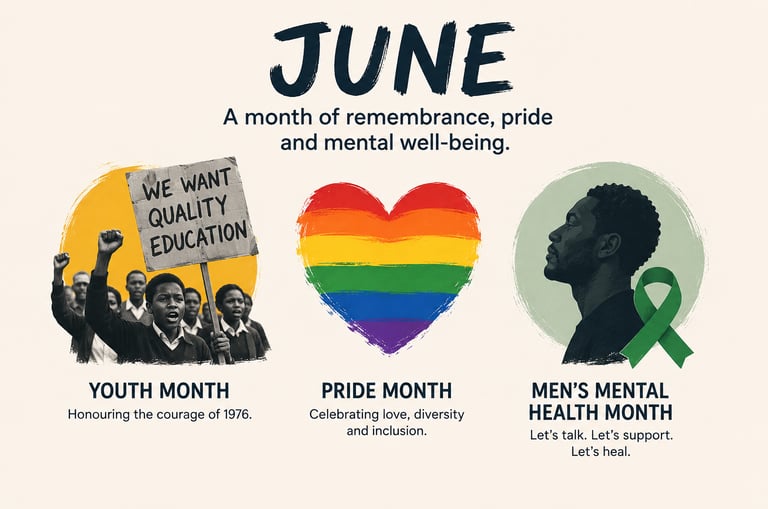
It is Youth Month, a time when we remember the bravery and sacrifice of the young people of 1976 who stood up for their right to quality education and a better future. June is also recognised around the world as Pride Month and Men's Mental Health Month.
At first glance, these observances may seem unrelated. However, they all speak to something deeply important: the need for dignity, belonging, opportunity, support and hope.
They also remind us of a reality many South Africans see every day. Too many young people are facing challenges that make it difficult to build the future they dream of.
Many are dealing with unemployment, poverty, educational barriers, mental health struggles, discrimination and uncertainty about what lies ahead. For some young people, these challenges do not exist separately. They happen at the same time and often make one another worse.
This raises an important question.
Are we doing enough for our young people?
The Reality Facing South Africa's Youth
South Africa continues to have one of the highest youth unemployment rates in the world. Millions of young people want to work, study, contribute to their communities and build better lives, yet many remain locked out of opportunities.
Behind every statistic is a real person.
A graduate who cannot find a job.
A matriculant who cannot afford further studies.
A young person who wants to work but cannot get a foot in the door.
A family trying to support their children despite limited resources.
For many households, education is still seen as the pathway to a better life. Yet when young people complete their studies and cannot find work, feelings of frustration, disappointment and hopelessness can begin to grow.
What Happens When Young People Are Left Behind?
When young people are excluded from opportunities, the impact is felt far beyond the individual.
Communities experience higher levels of poverty, social challenges, substance abuse, crime and poor mental health. Young people who lose hope in the future may begin to disengage from education, community activities and opportunities for personal growth.
A generation that feels unheard can become a generation that stops believing in its own potential.
That should concern all of us.
Because when young people struggle, communities struggle too.
Men's Mental Health Is Everyone's Responsibility
June is also a time to shine a light on men's mental health.
For many years, boys and men have been told to be tough, stay strong and keep their emotions to themselves. Too often, asking for help is seen as weakness rather than courage.
The result is that many men suffer in silence.
Mental health challenges do not disappear simply because they are not spoken about. Anxiety, depression, stress and trauma affect people from all walks of life.
The responsibility for men's mental health cannot rest on men alone. Families, schools, workplaces, faith communities, community organisations and government all have a role to play in creating spaces where boys and men feel safe to ask for help.
When we teach boys healthy ways to express emotions, build relationships and deal with challenges, we help create stronger families and healthier communities.
Mental health is not only a men's issue. It is a community issue.
Pride Month and the Right to Feel Safe
Pride Month reminds us that every person deserves dignity, respect and safety.
South Africa has one of the most progressive constitutions in the world when it comes to protecting the rights of LGBTQIA+ people. Yet many people, especially young people, still experience bullying, discrimination, exclusion and violence because of who they are.
No child should have to live in fear.
Schools, families and communities all have a responsibility to create environments where young people feel safe, accepted and supported.
Inclusion is not about agreeing on everything. It is about recognising the humanity and worth of every person. It is about ensuring that no child is denied opportunities, support or protection because of their identity.
Every young person deserves the chance to learn, grow and dream without fear.
These Challenges Do Not Exist in Isolation
Youth unemployment. Mental health. Educational inequality. Social exclusion.
We often speak about these issues as if they are separate.
The reality is that they are deeply connected.
A young graduate who cannot find work may begin to experience anxiety or depression.
A learner who is bullied may struggle to perform academically.
A young person living in poverty may have little access to mental health support.
A child who feels excluded may lose interest in school altogether.
The challenges facing young people are interconnected. That means the solutions must be interconnected too.
What More Can Communities Do?
There is no single solution to the challenges facing our youth. However, communities have the power to make a meaningful difference.
· Invest in Literacy
Strong literacy skills are the foundation of educational success. Communities should continue to support reading programmes, libraries, book access and literacy initiatives that help children develop a love for reading from an early age.
· Expose Young People to Opportunities
Many young people cannot aspire to careers they have never encountered. Career fairs, mentorship programmes, workplace visits and exposure to professionals can help learners make informed decisions about their futures.
· Create Safe Spaces for ConversationYoung people need spaces where they can talk openly about mental health, identity, relationships, education and their hopes for the future without fear of judgement.
· Support Entrepreneurship and Skills Development
Not every young person will find formal employment. Communities should encourage entrepreneurship, innovation and practical skills development that empower young people to create opportunities for themselves and others.
· Build Strong Partnerships
Schools, businesses, non-profit organisations, government departments, faith communities and families all have a role to play. Real change happens when people work together.
Our Commitment at The Tlotlego Smiles Foundation
At The Tlotlego Smiles Foundation, we believe that every child deserves the opportunity to thrive.
Our work focuses on literacy, educational support, career guidance, creativity and holistic child development. We understand that educational success is closely linked to emotional wellbeing, community support and access to opportunities.
As we reflect on Youth Month, Pride Month and Men's Mental Health Month, we are reminded that these conversations are not separate.
They are conversations about people.
They are conversations about belonging.
They are conversations about opportunity.
Most importantly, they are conversations about the future we are building for the next generation.
Every child matters.
Every voice matters.
Every dream matters.
The future of South Africa will be shaped by the choices we make today.
The question is not whether more can be done.
The question is whether we are willing to do it.
Together.